
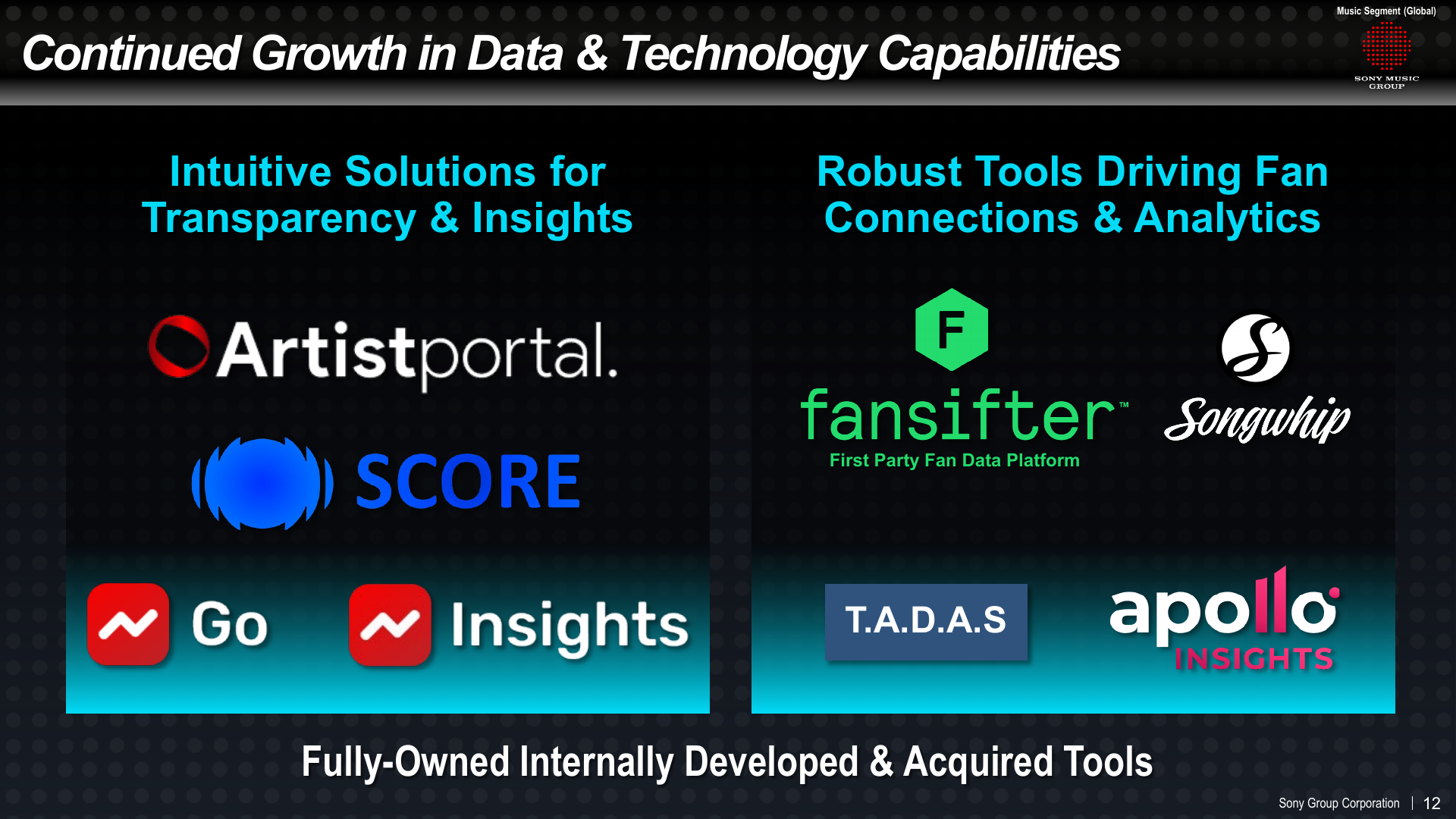
In June 2025, Sony published for investors the annual presentation of its music division, led by Rob Stringer. On slide 12, under the heading "Continued Growth in Data & Technology Capabilities", sit the logos of eight tools. One of them belongs to an Estonian startup Sony had bought the year before, Fansifter. Under the logo, the caption: "First Party Fan Data Platform".
The footer of the same slide says all of those tools are "Fully-Owned Internally Developed & Acquired Tools". One of the world's three major labels is telling the people who invest in it that it has its own tools to connect with its artists' fans and analyse them.
From ticketing in Estonia to a Sony asset
Fansifter was born in Tallinn in 2019. One of its founders and its CEO, Aivar Laan, came from the live events business, where he had built a ticketing platform.
Before the acquisition, the company described itself as a collaborative customer data platform, built for businesses that live off fans. The idea was to pool the first-party data of several partners around the same career, such as the artist, the manager, the label, the promoter and the merch store, in order to sell more.
In October 2024, Sony Music announced it had bought Fansifter, at an event in London. The price was not disclosed. The official press material describes the tool as a Sony Music solution that helps artists and their teams use data to understand and reach their audience. In Sony's own words, "from casual fans to superfans". The company's website is no longer online.
How it works, according to the buyer
At the same event, Sony Music's chief product officer, Jacob Fowler, gave a demonstration of the tool. Music Business Worldwide reported that it sorts each artist's fans into superfans, engaged, casual and new, based on what they do: album pre-saves, newsletter sign-ups, virtual merch purchases. According to Fowler, since the acquisition Sony has been building its own algorithms that recalculate those groups twice a day.
Fowler's example was an exclusive translucent blue vinyl that the label wants superfans and engaged fans to get first. "Those fans have told us that they want to make sure we reach them on SMS, as soon as this is available", he explained. The tool filters who gets the alert.
The example shows the label combining segmentation and direct contact: it knows which group each fan is in and which channel that group asked to be reached on, and it speaks to them without going through a social media algorithm. The managing director of Ministry of Sound, a label within the group, described one use: the tool makes it easier to understand the audience, "especially when we are starting from scratch with a brand new artist".
For a signed artist, that is a powerful structure working in favour of their release.
From records to shows
In May 2024, the Fansifter logo appeared on another slide of the annual presentation, titled "Building Fan Connections Across All Revenue Streams". At the top, music's revenue fronts: streaming on nine platforms, short-form video, games, artificial intelligence, merch, live, and partnerships with other Sony group companies. Beneath all of them, a band called "Fan Engagement Strategy", with a four-step ladder of fans.
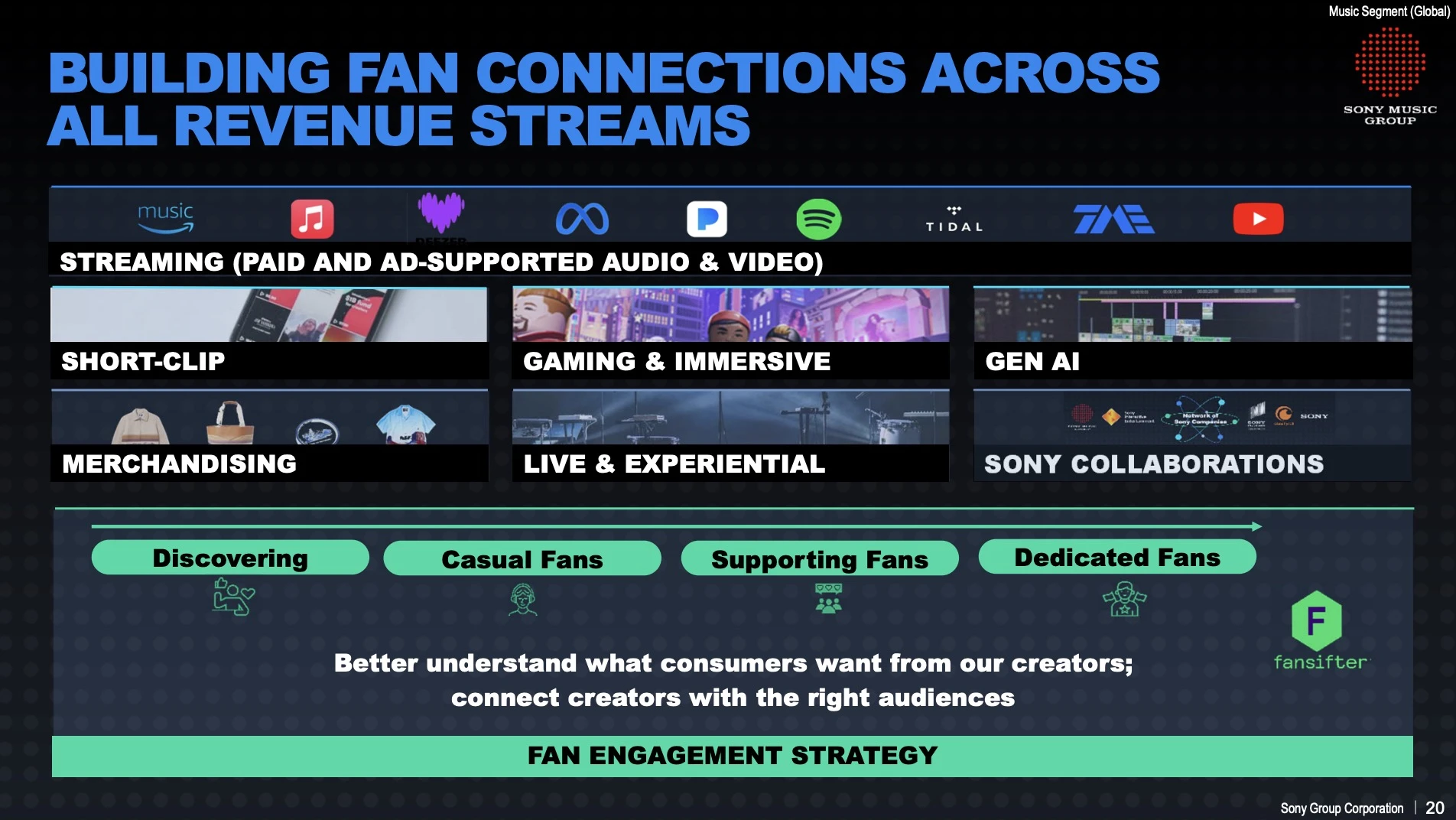
The design puts fan data at the base of all those fronts, from records to shows. The line chosen for the slide, "connect creators with the right audiences", defines the role Sony gives the label: the one who makes the connection.
First party, in data vocabulary, is whoever collected the data in a direct relationship with the consumer. In Sony's caption, the first party is Sony.
Sony is not alone
Other companies in the business describe, in their own documents, structures for knowing or reaching their audience. In its 2025 annual report, Universal said more than 200 million fans were registered to receive communication from the company's websites. On the July 2026 earnings call, Live Nation's chief executive, Michael Rapino, summed up the company's goal: look for any discovery signal that helps sell tickets, "as long as we own the transaction". Brazilian live entertainment company T4F lists a base of more than 8 million customers among its competitive advantages. In a different model, Deezer, in the terms of its Deezer Club promotions in Brazil, says it may take into account an internal "fan score" to choose who wins tickets, without disclosing the formula.
They are different mechanisms, each on its own side of the counter, for identifying, registering or reaching the fan.
Who was left without one
According to a 2024 study by MIDiA Research with Amuse, 95.5% of artists release music on their own, through a distributor or an artist services platform. Fewer than 5% are signed to a label. The same study notes that, among the things artists and managers want most from streaming platforms, is direct access to their own fans' data.
For those artists, and for the managers who look after them, fan data tends to be scattered across distributor, ticketing, store and social platforms, with no layer that brings it together. A signed artist, for their part, depends on their contract to know what, of that whole structure, stays with them when the contract ends.
Your platform already exists, it is just scattered
Read together with the demonstration, Sony's material sketches three stages: collect, unify and activate. The artist's team already collects at several points.
Collection can run through the pre-save on the artist's own smart link, the buyer list of a show the team produced, the merch store and the fan club sign-up form. What many teams are missing is bringing those bases together in one place, with consent and with someone on the team responsible for them. With a unified base, you can tell apart, for example, who buys from who only listens.
Sony used SMS in its example. In Brazil, the channel closest to the fan is WhatsApp, and fans do not need to download anything to hear about the vinyl, the presale or the extra show. The same data can help sharpen paid media: fan lists can feed Custom Audiences on Meta, TikTok and Google, and serve as the base for finding similar audiences.
Sony named its own and showed it to investors. If tomorrow your artist needed to tell their 500 most engaged fans in São Paulo about an extra date, on which platform does that list live, and whose is it?
Read also: Jão's greatest asset · The superfan is worth a house of your own