
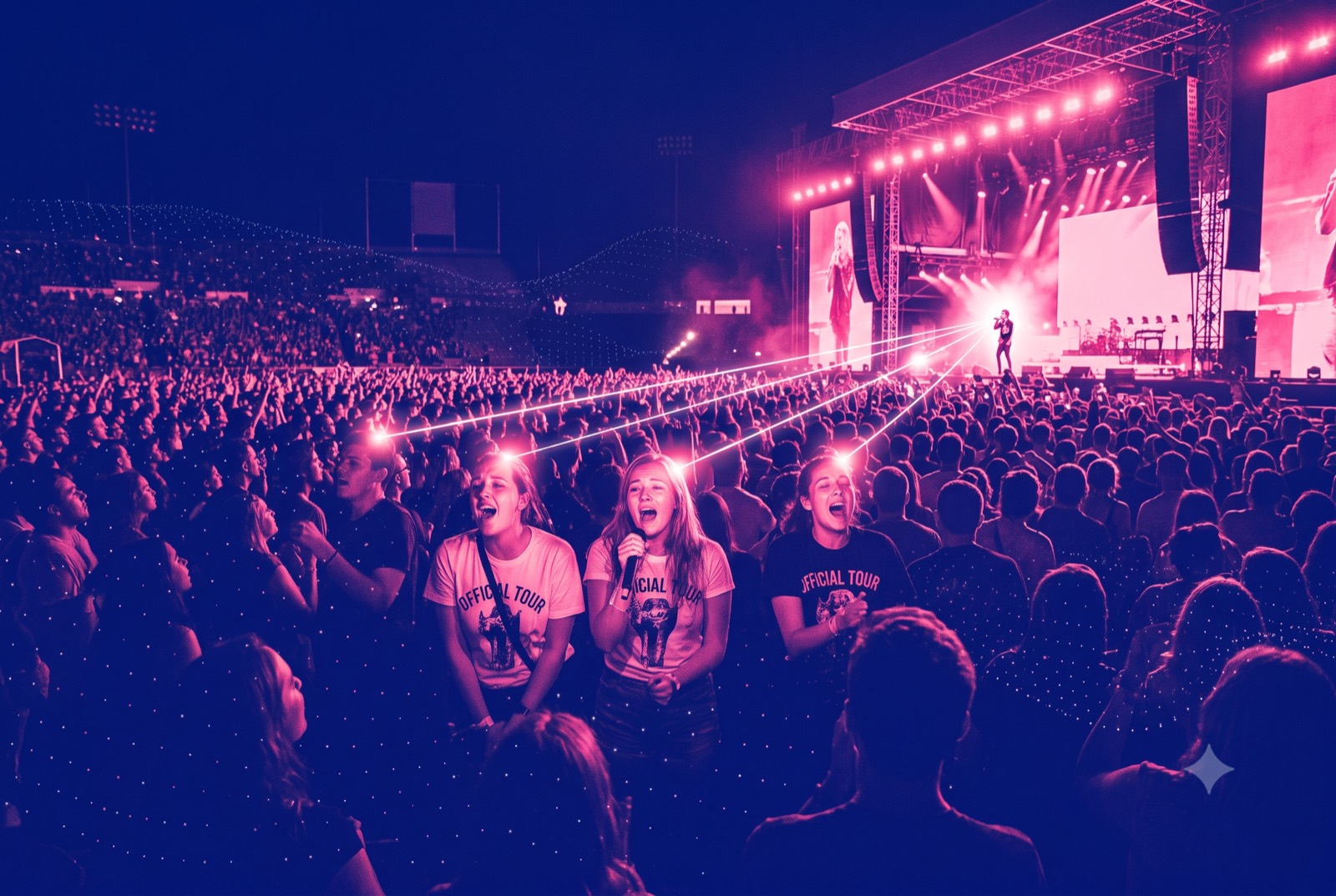
There's a small slice of any artist's audience that accounts for most of the money. That's not a consultant's opinion: it's what the biggest companies in the business wrote in their own investor documents. The superfan became the center of the industry's strategy because the math works like nothing else. And if they're worth that much, the only question that matters for whoever runs the career is: who keeps that value?
Few, but almost everything
Start with the size of the prize. In its audited annual report (the 10-K for 2025), Warner records, citing Luminate: super fans are about one-fifth of the audience, but "73% of them purchase physical merchandise and spend 105% more than the average music listener." Spotify adds the figure every manager should have on the tip of their tongue: superfans (roughly 2% of listeners) account for close to half of an artist's ticket sales, and a disproportionate share of streams. They're also the ones who share the most: several times more likely to recommend the music to their own network.
In business terms: the superfan is the highest-lifetime-value customer in the catalog. They buy the ticket, the vinyl, the shirt, the deluxe edition, and bring in new people for free. An honest caveat: these figures are from markets like the United States (Luminate, Spotify), not Brazil. But the behavior pattern is universal, and in Brazil it tends to be even stronger: the Brazilian fan is famously one of the most dedicated in the world.
Willing to pay more, and the majors know it
The superfan doesn't just spend more: they want to spend more. Universal presented, at its Capital Markets Day, research on its own base: "20% of subscribers say they're willing to pay for a premium tier", with early access to releases, deluxe editions, hi-res audio, listening-party invites and artist Q&A sessions. Warner gave a concrete willingness-to-pay number: Suno's 2 million subscribers pay, on average, US$12.50 a month for interactivity: "clear evidence," in the company's words, "of the willingness of superfans to pay more."
The whole market has already put a figure on it. Goldman Sachs estimates that monetizing the superfan represents an incremental opportunity of US$3.3 to 6.6 billion for the industry by 2035. Nobody spends this energy on an audience that doesn't pay. The willingness is proven; what's in dispute is the channel it runs through. (The tier and market targets are the companies' own projections and intent research, not realized revenue.)
But which way does the money flow?
Here's the part the manager needs to see. The industry didn't discover the superfan out of charity; it discovered them in order to capture them through its own channels. The premium tier belongs to the DSP. The direct-to-consumer store belongs to the label. The fan-club app belongs to the platform. If your artist's superfan pays through those channels, the one who keeps the relationship (the name, the email, the history, the next offer) is the platform. You get a slice: a royalty, a wholesale cut. It's the same rented land, now on the most profitable layer of the career.
It's not that those channels are bad. It's that, if you depend only on them, the superfan isn't yours; they belong to the intermediary, who rents you access to them.
The manager's math
Think of the superfan as an asset, not a vanity number. They're the customer who powers the entire flywheel: release, tour, merch, membership, brand partnership. Each of those revenues depends on one thing: knowing and reaching the superfan directly, at the right moment. When you own the relationship (email, SMS and, in Brazil, above all WhatsApp), the superfan's spend flows across all your revenue lines, and compounds each cycle: every show, every drop, every release adds signal, and the next one gets sharper. When you don't, every conversation with your most valuable fan runs through someone else's cash register.
The difference, over a career, is enormous. An artist whose manager knows the 5,000 superfans by name, city and purchase history opens the pre-sale, the merch drop and the membership campaign without asking anyone's permission, and measures the return on each. An artist whose superfans live only inside the platform depends on the algorithm, the tier and someone else's rules to reach the very people who sustain them.
A superfan is worth a house of your own. The question is whether you'll own it, or keep renting a room in the platform's house, paying rent every time you want to talk to the people who fund the career.