
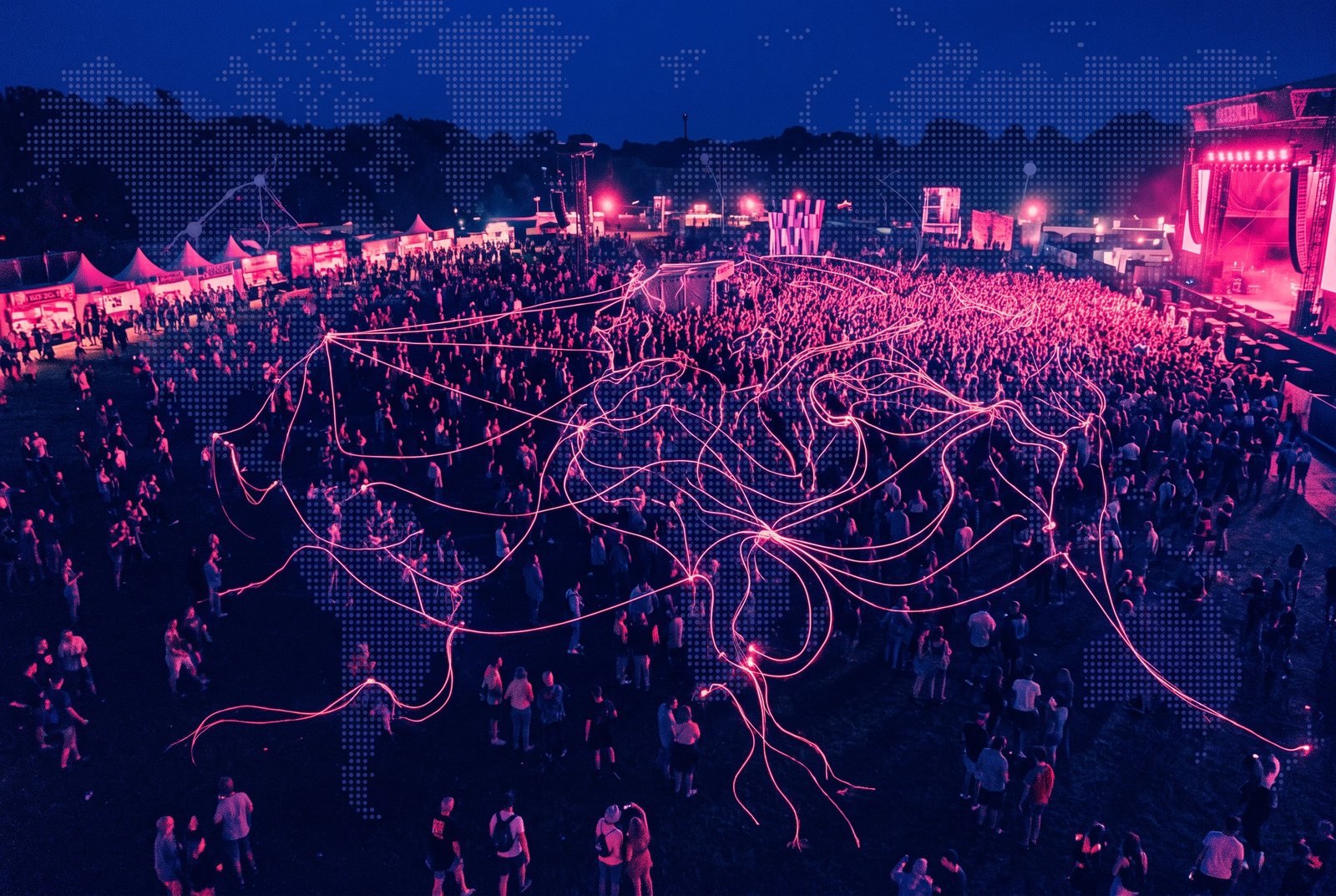
While Rock in Rio runs, a second operation runs alongside it: tickets, app, consumption and sign-ups being stitched into a single view of the audience.
One clarification before we start, because this subject turns into conspiracy theory for no reason. Nothing below is a leak or a guess. It has been published by the parties themselves, in a corporate blog, in institutional material and in press interviews.
Zoox has publicly described part of this operation since 2022. In September 2024 the company detailed the data sources it integrates at the festival; in September 2026 it presented the design again at the opening of the new edition.
The interesting part has less to do with technology than with architecture. The information already exists. The work consists of making it stop functioning as isolated pieces.
What is being stitched together
According to Zoox, the integrated sources fall into four groups.
Tickets, with the buyer's tax ID and transactional sale data. Sign-ups, with full name, address, age, place of birth and occupation. Consumption, with drinks purchased and giveaways received. And behaviour, with shows attended plus interactions and posts on social media.
Each piece originates in a different part of the operation. Tickets are sold by Ticketmaster. Advance food and drink purchases happen in the festival's own app. Consumption inside the venue runs on Zig's cashless system. The 22 brand activations at this edition add further sign-up lists.
One person passes through all of these points. The systems, however, were each designed for their own specific function.
That is where the data operation described by Zoox comes in: organising, qualifying and connecting this information to build a single view of the audience. Among the deliverables the company states are audience analysis, behavioural insight, personalised campaigns and multichannel communication journeys.
What changes with size is not the technology. It is having someone tasked with joining the four.
The value lies precisely in the connection. A ticket shows who bought. Consumption shows what that person did during the event. A sign-up reveals information the box office never captures. Behaviour adds another layer. Kept apart, these are operational records. Brought together, they can support decisions about audience, communication and experience.
Why a festival does this
Luis Justo, CEO of Rock in Rio, explained in November 2025 that planning an edition begins with analysis of data from previous ones, collected by both partners and suppliers. The examples he cited include heat maps by time of day, location and age range, and correlations between musical genres and audience profiles.
The archive also gives a sense of the scale: 24 editions and 14 million accumulated visitors, according to the festival.
Alexandre Guerrero, CEO of Eletromidia, summed up the shift in priority:
Data, which used to be a footnote, has become the first line of the brief.
The same logic appears in the words of Rafael de Albuquerque, CEO of Zoox:
If there is a formula for creating an extraordinary festival, we don't know it. But behind it there is a solution that supports decision-making.
Data matters here because it shortens the distance between what happened and the next decision. Circulation history can shape where structures are placed. Audience profile can inform sponsorship negotiations. Consumption behaviour can help size an operation. The previous edition stops being merely a memory and starts working as evidence.
Heineken, and data that feels like experience
Heineken's activation with The Clinker wristband shows another side of the same logic.
Brought from Coachella to Rock in Rio, the wristband syncs with the participant's Spotify account. Those without an account can fill in a short preferences form. When two people toast using equipped cups or cans, the device calculates the musical affinity between them. The result appears as lights on the wristband itself; above 90% compatibility, the Super Clinker kicks in.
The stated purpose, according to Beatriz Ruiz, experience and sponsorship manager at Heineken Group, is to bring people together.
There is a second reading, and it matters to anyone who produces events. Notice what the wristband does without: it never asks what your favourite music is. It reads your actual listening history, which is far more accurate than any self-declaration on a form. And the person hands that over in a gesture lasting two seconds that returns a green light and a conversation with a stranger.
That principle is more interesting to a producer than the wristband itself. The mechanism that collected the richest information was the one that least resembled information collection. The best capture is the one that gives something back at the very moment it asks.
The same sources exist at your festival
This is where the Rock in Rio case becomes useful for smaller events.
The design rests on four sources that appear in a great many event operations.
Ticket. The sale generates information about the buyer. The difficulty usually lies in accessing and organising that data after the transaction.
App. A proprietary app is only one of the options. Website sign-up, waiting list, pre-sale form and newsletter subscription all serve a similar function: registering intent before the event.
Consumption. Cashless, tab, voucher or token produce different levels of information about what was bought and, depending on the operation, by whom.
Sign-up. Credentials, prize draws, registrations and brand activations also create databases that tend to stay separate once the action is over.
It is worth noticing what this means. The large festival has the same categories of information as the small one. What it has in addition is someone tasked with joining the four. The difference lies in assigned responsibility, not in available technology.
A first step would simply be to match these databases on a consistent key, such as phone number or email, in line with applicable data protection rules. That alone moves you from four independent lists to a more organised view of who bought, signed up, consumed or took part in an activation.
The difference starts to show in the decisions that matching makes possible.
Ownership of the database has to be part of the project
There is, however, a question that comes before the tool: who controls the resulting database?
If the unified information exists only inside a supplier's system, the operation may produce excellent analysis and still leave the producer dependent on that supplier to rebuild it later.
Brazil's data protection law, the LGPD, distinguishes between controller and processor. The controller is the party that makes the decisions regarding the processing of personal data; the processor carries out that processing on the controller's behalf.
That definition needs to be reflected in the contract, alongside rules on access, purpose, security, retention, export and termination of the relationship. A database built across several editions is too important an operational asset to disappear when the supplier changes.
And the other 365
This point gains weight when you look at festival survival.
According to the Panorama dos Festivais Brasileiros 2025, published by Mapa dos Festivais, Brazil held 366 festivals in 2025. Of the events that took place in 2024, 174 had no edition in 2025. Among those, 90% were small and mid-sized.
The same study points to distance from the community as one of the causes associated with festivals pausing or closing. In the survey of producers about what keeps an event standing, building community and a sense of belonging appears as one of the central factors.
Fabrício Nobre, founder of Festival Bananada, also places understanding of data and audiences among the pillars of survival, citing opinion research to guide decisions such as when to announce an edition and how to correct problems in the fan's journey.
The two ends meet here.
Rock in Rio has accumulated 24 editions and built an operation dedicated to connecting different sources of information. A festival of ten thousand people can start at a far smaller scale, using the information it already produces at every edition.
The advantage lies in turning that inventory into operational memory.
The box office knows who bought. The sign-up knows who showed interest. Consumption shows what happened during the event. Activations record other interactions. As long as each of these sits in a different place, they tell incomplete stories.
Once they start talking to each other, they begin to answer the questions a festival needs to carry into the next edition: who came back, who stopped coming back, what they consumed, which experiences they joined and which audiences need to be reconnected.
Rock in Rio turned this into an operation. Your festival can start by taking inventory.
If your next edition were today, how many of those four lists could you open before the end of the day?