

Almost everything I write about fan data starts from an argument about ownership: the relationship with the people who like your artist, or your festival, today belongs to a platform and ought to belong to you. The argument is true, and it mostly convinces people who already agree with it.
This piece starts somewhere colder, from the books of whoever produces. With ticket prices flat and costs rising, first-party data starts working as a cost defence.
In Brazil, the ticket stayed flat and costs went up
The Panorama of Brazilian Festivals 2025, from Mapa dos Festivais, and the report that accompanies the survey show that equation from both sides.
The price. The average ticket was R$338.34 per festival day in 2025, a figure the Panorama describes as similar to 2024. With positive inflation over the period, a price that stays flat in current reais means a cheaper ticket in real terms.
The cost. The report describes operating costs inflated by air fares and very expensive structures, growing at a pace far above the ability to raise money from brands and the box office. Gabriela Parente, of Festival Zepelim, in Ceará, sums it up: "The numbers do not add up: the cost of artists and logistics has tripled, but the audience cannot take a more expensive ticket and sponsorship has not kept pace."
The fight over line-ups. The organisers of Festival CoMA add a layer that deserves debate. According to the festival, the competition for acts has become unfair, with large players locking artists into exclusivity, which inflates fees and weakens independent promoters. Michelle Cano, co-founder of CoMA, describes that competition as "cannibalistic".
The result. Of the festivals held in 2024, 174 had no edition in 2025, and 90% of them were small and mid-sized. The national total held steady, at 366 festivals, because debuts and comebacks offset the departures.
Abroad, the pressure shows up in prices and in small venues
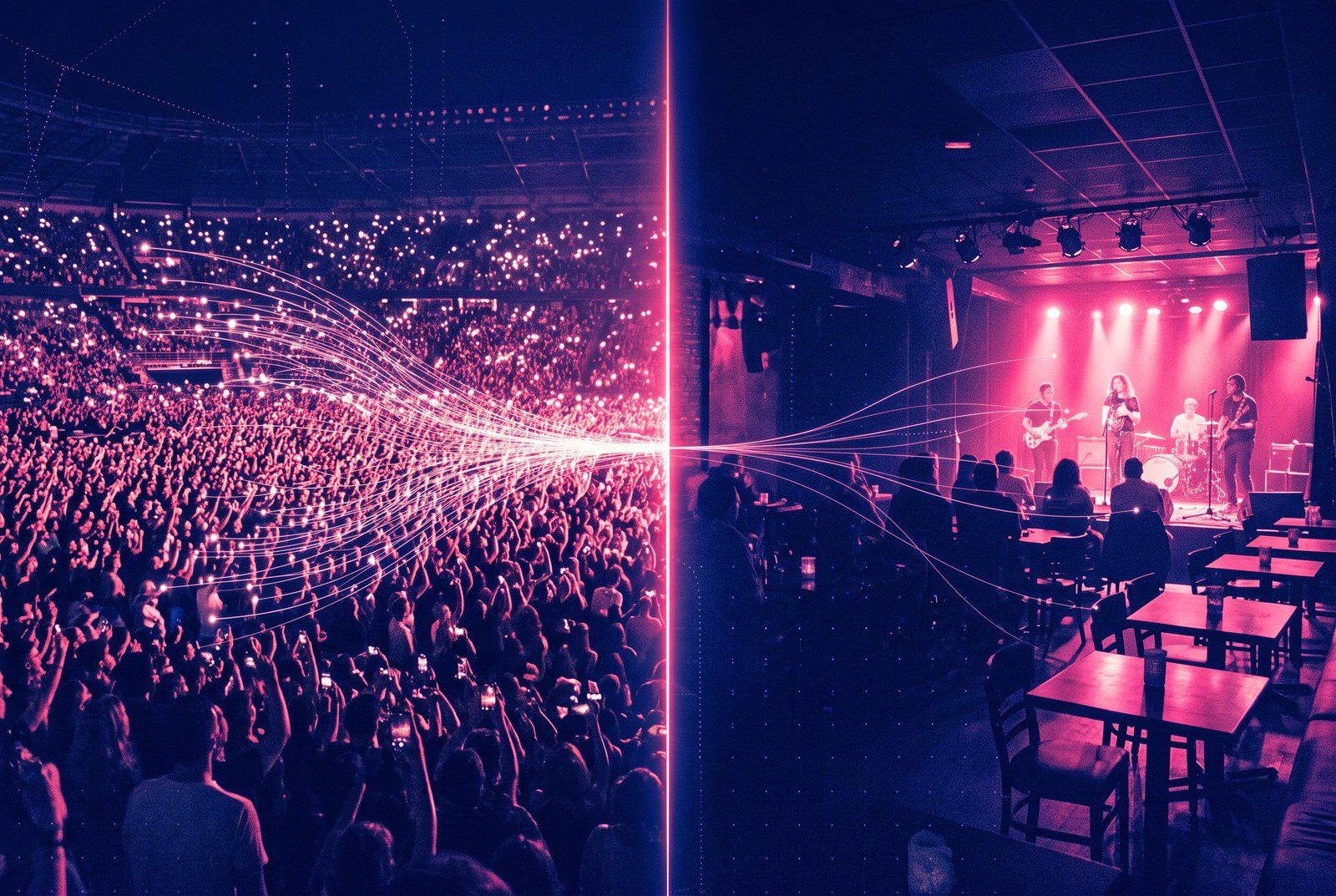
The midyear report from Billboard Boxscore, covering October 2025 to March 2026, shows global live split in two. In stadiums, arenas and amphitheatres, earnings rose more than 20%, driven in part by platinum tickets and VIP packages. In venues of up to 2,500 capacity, small theatres and clubs, earnings fell almost 9% and attendance 6%. Among the 20 highest grossing venues with 5,001 to 10,000 capacity, the rise was 7.3%. The squeeze has an address: the smaller venues.
The average ticket price of the top 50 tours fell 6.3%, to US$130.36, after already falling 5.5% in the previous report. With earnings at the top rising, the equation balances through volume and through the premium product sold on top of the standard ticket. The total for the period remains below the 2024 peak, and the report sees signs that the era of explosive post-pandemic growth has ended. Sara Mertz, of Tixr, was blunt with Billboard in May: "100%, I do think a correction is coming."
Abroad, the correction shows up in the price of the big tours and in the earnings of small venues. Here, it shows up first as a festival that does not come back.
Three places the margin can come from
For anyone producing with a squeezed margin, the immediate problem is arithmetic: revenue per ticket is not going up, costs are, and the margin has to come from somewhere. There are three possible places.
Charge more, which is precisely what the price data shows to be difficult.
Cut production, which degrades the experience and accelerates the loss of audience.
Reduce the cost of selling each ticket, by talking directly to whoever has already bought.
The third is the only one that protects the margin without touching the price or the stage, and it is there that a first-party base becomes a line in the spreadsheet.
When the top of the line-up gets concentrated
The exclusivity reported by CoMA has a practical consequence. When the most sought-after acts end up with whoever has the most capital, the independent promoter loses leverage on the thing that traditionally sold tickets: the name at the top of the poster.
One asset stays out of that dispute: the relationship with the audience that has already bought from you, organised into a base of your own. It is built edition after edition, and no competitor can lock it into exclusivity.
First-party data as a cost defence
Every show has an acquisition cost per ticket sold: paid media, platform commission, the discount you give to move unsold stock in the final week.
The marginal cost of talking to whoever has already bought sits well below the cost of finding a new buyer through paid media. Building and maintaining the base has a tooling and operating cost, and that cost is diluted with every show, while paid media charges again with every campaign.
With prices flat, every real taken out of the cost of selling a ticket goes straight to the margin, without depending on the market getting better.
Paid media is still necessary, and it aims better: the list of real buyers becomes a Custom Audience on Meta, TikTok and Google.
Information before risk
A first-party base delivers a second gain, as important as the saving. A presale to people who have already bought measures demand before you commit to fees, venue and production, and the decision about the next edition starts being made with a number in hand.
For those at the top of the market, first-party data is optimisation. For anyone producing a small or mid-sized festival, the size of those that most often failed to return in 2025, it changes two lines of the accounts: it lowers the cost of selling each ticket and it shows demand before the money leaves the bank.
Before signing the next artist fee, how many tickets do you know you can sell without paid media?
Read also: You sell out the show and have no idea who was there · The next edition starts today