
Brands already know music sells. The problem starts when they have to say to whom.
The first part is settled, and Mapeamentos Sonoros sums it up in one sentence: "From the ears to the wallet: music sells." In the study by Tecla Music Agency with On The Go and COPA, carried out in 2025, 70% of the 150 members of the public interviewed said they had already bought something because of the music in a campaign.
The second part appears when the same study interviews 100 professionals from brands and the music industry in leadership roles. The most cited obstacle to working with music is the difficulty of measuring return on investment, at 45%. And the most cited challenge in using music in a campaign is getting the music to the right audience, at 70%.
What plays and who listens
The study uses two icons throughout: what plays and who listens. The split organises the three practices it considers the minimum for a brand to work with music.
The first is translating the brand's DNA into a sonic identity, and it belongs to whoever looks after what plays: the curation. The other two are, in the study's words, "knowing your audience to create a consistent, high-impact strategy" and "being creative in the use of music and in the way it is measured". Those two depend on knowing who listens.
In Billboard Brasil's article on the launch of the study, in September 2025, Paulo Sattamini, founder and creative director of Tecla Music, defined music as "an invisible signature of brands, capable of reducing the noise of information overload and creating genuine, lasting connections with people". The connection happens with people, and measuring connection requires knowing who they are.
When reach was enough
It was not always like this, and the study shows the shift in three phases.
Between 1960 and 2000, music was a vehicle. Sattamini describes its role in advertising at the time: "In the advertising context, music was limited to creating original tracks (jingles, parodies, spots...). It was a vehicle for reaching a goal: making a message memorable." The jingle played on radio and TV, and the medium's audience served as the measure.
Between 2000 and 2020, music became social capital, the place where everyone was. From 2021 onwards, the study calls its role that of an ally, in a relationship "shaped by our participation in micro-communities and our association with fandoms". When the audience organises itself into small communities, the aggregate number says little, and what starts to matter is who is in each one.
Niche is the new mainstream
Among the study's trends, one has a direct consequence for sponsorship. The study writes that "if niche is the new mainstream, music is the ideal ally for connecting common interests between brands and people", and that it has "the power of the match". Events and sponsorships appear among the three main trends for 63% of the specialists.
One of the professionals interviewed takes the idea into practice: "Sponsor mid-sized and small artists. Promote songs by smaller artists. Fragment campaigns, giving more regional artists a chance."
The recommendation makes sense, and it comes at a price. A campaign split across ten regional artists speaks to ten small audiences, and the more fragmented the audience, the less the follower count helps to choose and to prove: it does not say who is there, nor what those people do after listening. The two questions from the beginning come back, now ten times over: who the brand spoke to, and what it sold.
Where the listeners are
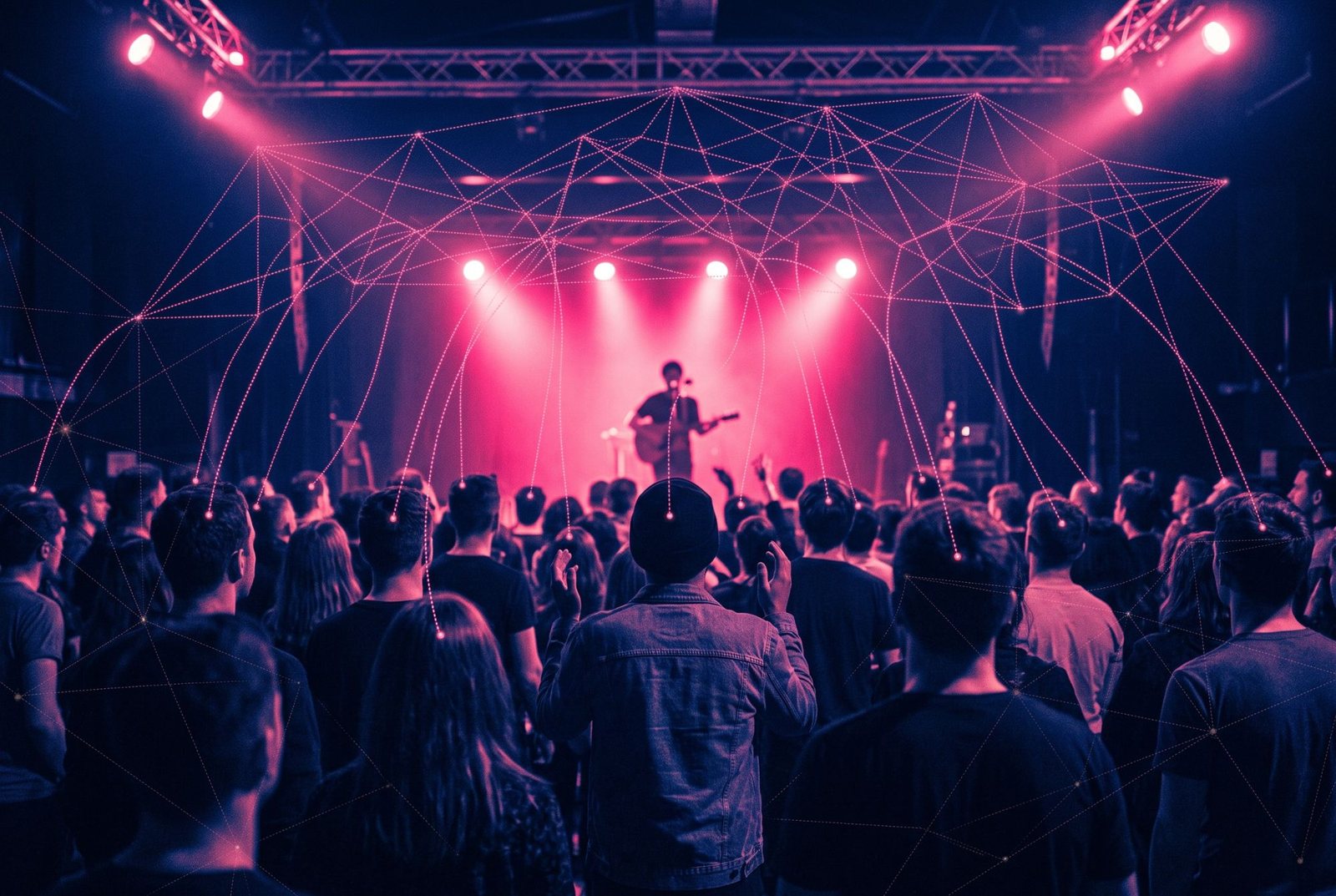
Today, the people who listen to an artist are scattered. The streaming platform shows the audience in aggregate numbers. The social network shows who interacts, under its own rules. The ticketing company knows who bought a ticket, and the store knows who bought merchandise.
Whoever is in a position to join those ends, with a name, a city and consent, is whoever keeps a direct relationship with the crowd: the artist and the festival. It is with them that fans buy, register and agree to receive messages, and that is why they can build this asset.
For the brand, this changes what can be asked of a sponsorship. Beyond reach, it can buy access to an audience that has given permission, with an attributable campaign. In the design I recommend, the fan consents to receive messages from the artist or the festival, which is responsible for that data, and the brand activates the audience through them, without receiving the individual-level base. Consent and a declared purpose are what Brazil's data protection law (LGPD) requires of whoever processes personal data, and they stay with whoever holds the relationship.
The two practices that depend on who listens are solved together: the brand knows which audience it reached and how much that sold.
For those who manage artists or produce festivals
If you manage an artist or produce a festival, the study carries a message. The brand that sponsors you has to show results to whoever approved the budget, and the data that shows results is your audience's.
Whoever arrives at a sponsorship negotiation with their audience organised (how many bought, which cities they came from, how many came back) offers the brand exactly what it says it has the most difficulty getting on its own. It is the difference between selling exposure and selling an activation that can be measured.
In your next conversation with a sponsor, when they ask who your audience is, will you answer with followers or with buyers?
Read also: Rock in Rio Created 216,000 Playlists. The Promoter Got Zero. · Jão's Greatest Asset