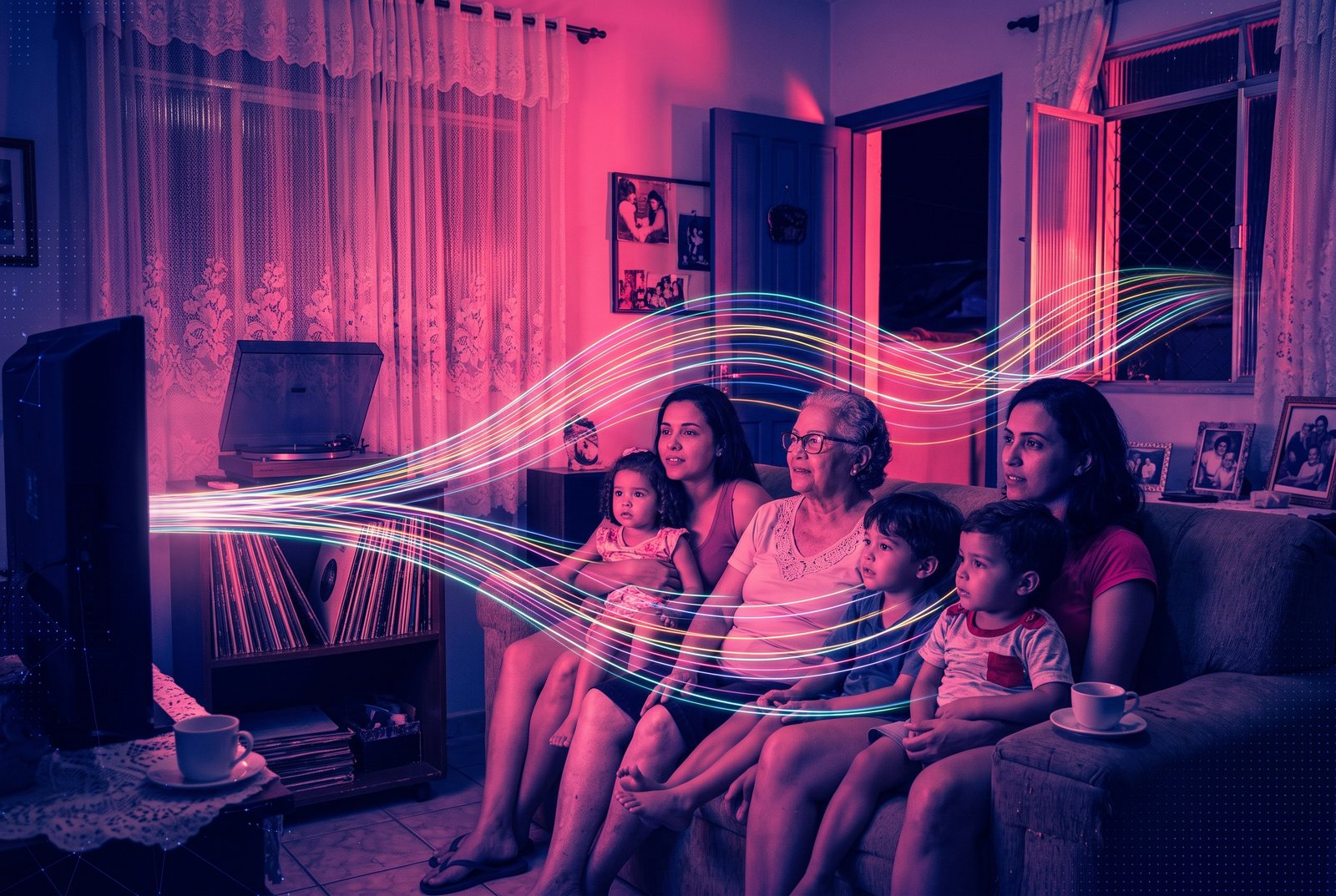
For readers outside Brazil, one piece of context first. The novela is the prime-time serialised drama that has anchored Brazilian television for decades: months-long runs, an episode every weeknight, and a soundtrack curated scene by scene. It is not a niche format. It is the country's shared living room.
I have watched novelas since I was a child, with my family, and I still watch them. I prefer them to streaming series, and the reason is simple: it is one hundred per cent national content, made here, about us.
I also admire the industry behind it, and not as a courtesy before the criticism. The sophistication of its language, technique and aesthetics is real, and the industrial scale of production that Globo built does not exist anywhere else in Latin America. Doing that, at that volume, at that regularity, is a feat.
And there is a part of this that is personal: a good share of my musical education came from novela soundtracks. Not from the television itself, but from the record. My parents bought the soundtrack, on vinyl, on cassette and later on CD, and it played at home outside the hour the novela was on. That is how a lot of music entered my life.
I kept that detail because it explains what changed better than any argument.
What the report showed
A story in Meio & Mensagem, published on August 21, 2026, went after the effect of novelas on the music market. The numbers it carries, provided by Spotify, are spectacular.
"Hourglass", by Balthazar, rose 7,223% in streams after entering Vale Tudo. "Pra Melhorar", by Flor with Marisa Monte and Seu Jorge, rose 1,236% in streams and 888% in saves in Quem Ama Cuida. Cristina Braga saw a 883% rise in monthly listeners. Chloe Qisha, 336% in followers. Mestrinho rose 58% and 80%, and Gal Costa, 32% and 30%.
Before going further, a caveat the nature of the data demands: these percentages come with no absolute base. Seven thousand per cent on a small base and seven thousand per cent on a large one are completely different phenomena, and there is no way to tell which is which from what was published. A percentage without a denominator is the best-dressed vanity metric there is.
That said, the direction is unmistakable and nobody needs the exact number to recognise it: a novela placement still moves a lot of people. It still moves me.
And that is precisely why this case matters
Almost everything I write about attention that does not become fandom rests on global data or on social media. MIDiA's research with ten thousand people shows that nearly half of the people who discover music on a social platform will not go and listen to it. TikTok converts followers into listeners at a low rate.
That always left an easy exit for anyone who wants to disagree: that is a TikTok problem. Feeds are shallow, algorithms are volatile, attention there lasts two seconds.
The novela closes that exit, because it is the opposite of a feed.
It is not vertical, it is linear. It is not an algorithm, it is human curation, done by people who pick a track for a scene. It is not a bubble, it is mass. It has prestige, emotional context and repetition, which is an advantage social media does not have: the same song comes back every night, attached to the same character, for weeks.
And it reaches people social media does not. Os Garotin say so very clearly in the piece, describing what the novela added as "exactly what was missing: the crowd we sometimes can't reach", the older audience that is not on the platforms they were already on.
So: better channel, better context, the audience that was missing. And the result, in terms of relationship, is still the same.
What is left after the spike
The report itself records the outcome, and it is the hardest passage in it. Mariana Volker sums it up: "Today you can have a song in a novela and still not fill venues, still not have a career developing."
Os Garotin say that "a novela placement used to be practically a guarantee of huge success" and that "the world has changed radically".
Follow the whole path of what happens. Someone is on the sofa, hears the song in the scene, likes it, picks up their phone and searches for it on streaming. Plays it two or three times. Maybe saves it.
At the end of that chain: the broadcaster kept the audience. The platform kept the listener. The label kept the sync fee. And the artist was left with a percentage change in plays.
Not a name. Not a city. Not a way of telling that person when the next record comes out.
It is the most rented audience there is, and the artist is not even the tenant: the lease belongs to someone else.
Where my vinyl memory fits, and where it does not
This is where I have to be careful, because the easy path would be to say things were better before. They were not, and an attentive reader knocks that down in two seconds: in the LP era, the artist did not know the name of whoever bought the record either. The label knew even less. Buyer data did not exist.
The honest formulation is a different one, and it is far more uncomfortable.
The exposure was always rented. What changed is that now someone is capturing the identity of whoever listened, and that someone is not the artist.
In the record era, nobody had the data. The relationship was mediated by an object that went on a shelf, and value was distributed crudely, but symmetrically in its ignorance.
It is worth remembering one attempt to break that open, because it has aged well. In the early 2000s, Lobão, one of the best-known figures in Brazilian rock, numbered a batch of 50,000 CDs, one by one, with a barcode and his signature, and backed a bill that would have made numbering mandatory in the country. It cost one cent per disc.
And look at the reason, because it was not the one I assumed. It was not about knowing who bought. It was about knowing how many were sold. In his words, "manipulating results is the most routine thing there is", and the example he gave was his own: "Me chama", which he claimed was the most played song of the 1980s in Brazil, showed 23,000 copies sold. The industry pushed back. The head of BMG at the time summed up the objection like this: "you cannot number CDs as if they were cars". And the fight was public enough to become a song: Lobão wrote "Capitão Gancho" about the president of Universal, who had gone on a television programme to discuss numbering dressed as the villain from Peter Pan.
In other words: the artist was manufacturing with his own hands, at one cent a unit, the measuring instrument nobody was going to hand him. Twenty-odd years later the ruler has changed subject, from how many copies shipped to who listened and where, and his place in the queue is exactly the same.
Today the broadcaster knows who watched. The platform knows who listened, how many times, in which city, what they played next. The advertiser knows. The artist still has a number.
He is the only party in the chain whose position has not improved in thirty years of digitisation. Everyone got a measuring instrument except him.
And the bill changed hands
There is a detail in the report that closes the reasoning. It records that the burden moved from the label to the artist, who now funds marketing and social media on their own.
That squares with a data point I use often: more than 95% of artists today release independently, through a distributor or an artist services platform, with no label deal. The model changed, and it changed for real.
The problem is not independence. It is that the bill was passed on without the infrastructure. The artist took on the responsibility of building their own audience, but was left with no access to the data that would make it possible. It is the worst combination: an owner's obligations, a tenant's instruments.
(The report also records that the labels approached did not respond or preferred not to take part. I note the fact without drawing a conclusion from it.)
What you can do, and it is less than it sounds
None of this means turning down a novela. That would be foolish: it is extremely high-quality exposure, with an audience no other channel delivers, and the repetition does work that paid media does not.
It means no longer treating the spike as a result and starting to treat it as raw material.
Before the premiere, if you know the song is going in, make sure a place of your own exists for people to go to. A page that is yours, not just the streaming link. A pre-save that leaves a contact behind instead of becoming just a number to post.
During the spike, the operational question changes from "how many streams went up" to "how many of these people can I identify". Even if the answer is a small fraction, a small fraction of an enormous spike is the biggest capture that artist will get all year.
And afterwards, when the spike passes, you have the one thing that survives the end of the novela: a list of people who liked it enough to raise their hand. Social media keeps doing what it does well, which is reaching new people, and so does television. What cannot happen is the relationship existing only there.
The soundtrack my parents bought went on a shelf and stayed. The song playing on a novela today reaches far more people and leaves no object behind, neither for the listener nor for the artist.
The last time a song of yours reached a lot of people at once, what was left afterwards?
Read also: The algorithm does not discover your music. You hand it over · Going viral is not the same as having fans