
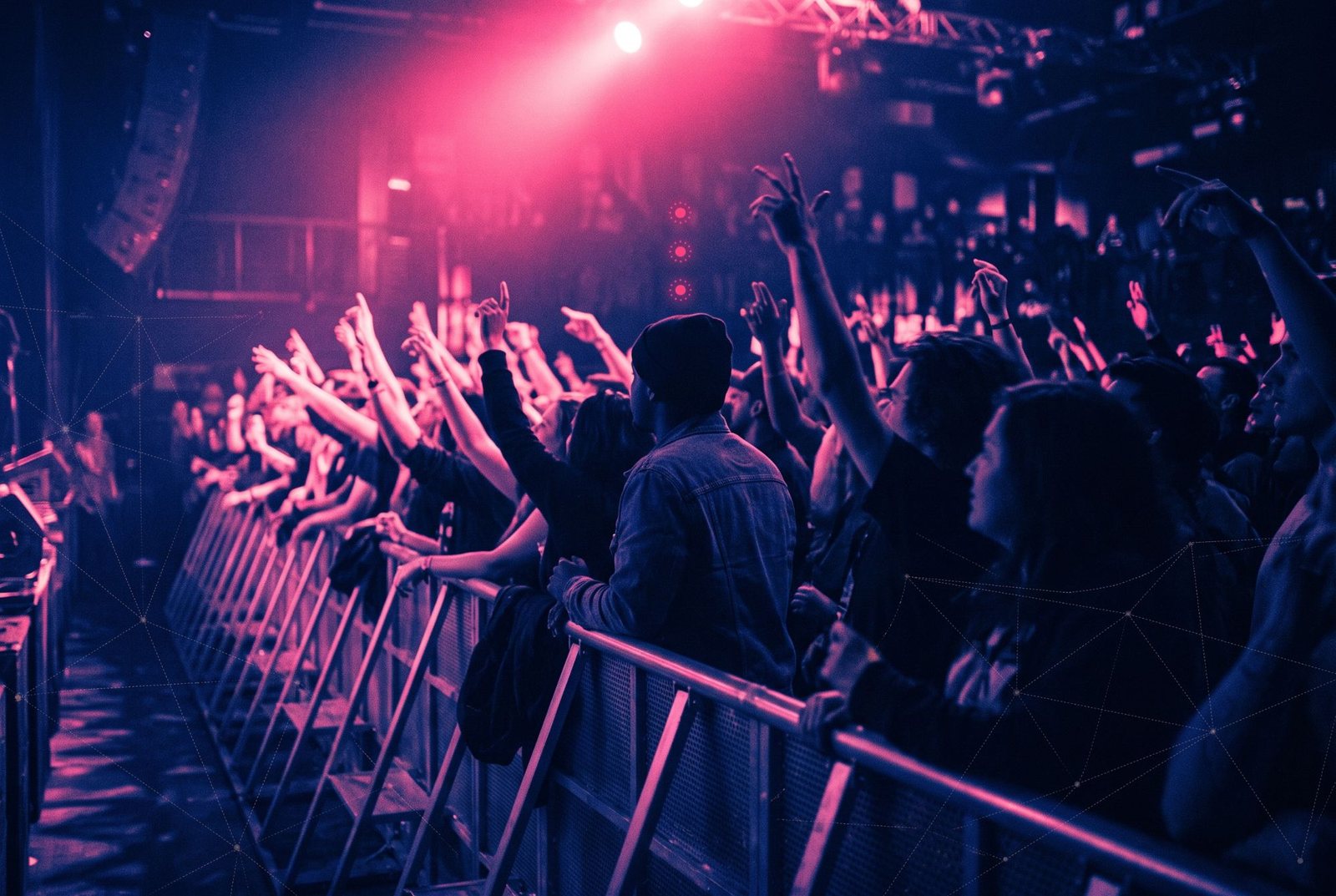
Tara Bess is 43, lives in Florida and spent nine months driving for a rideshare app, on top of her job, to save up for a Harry Styles show at Madison Square Garden. She paid $1,400 on a resale site for a VIP ticket with early entry and a spot at the barricade. She told the Guardian on 21 September 2026: "When you're up close, you can see him closing his eyes and almost meditating to the music."
The resale site is what holds Tara's name. Whether it reaches the artist depends on what is contracted between the artist, the primary ticketing company and the platform where she bought.
The point where the math turns
Two days after that story ran, Please & Thank You, the American company that operates VIP programs for artists including Sabrina Carpenter and the Backstreet Boys, published an analysis of nearly one million VIP transactions covering 2024 to 2026. What it set out to measure was repetition.
The count runs among people who have already bought VIP at least twice, and the curve looks like this: of those buyers, 20.1% reach a third purchase. Those who reach the third have a 37.6% chance of making a fourth. From there the curve rises at every step: 53.2% from the fifth to the sixth, 65.7% from the seventh to the eighth and 80.6% from the ninth to the tenth. The study calls the 20.1% "the hardest cliff in the funnel" and shows that, past it, retention climbs fourfold across the next seven transactions.
Eddie Meehan, the company's CEO, sums up why that matters: "There's a ceiling on what a fan will pay for a single ticket. There isn't one on what they'll spend coming back for more."
The most useful line in the study, though, is an admission. This, they write, is "the inflection point most of the industry has never measured."
To see the curve, you have to see the person
A repeat-purchase curve only exists if someone can state that today's purchase and one from two years ago belong to the same person. Please & Thank You can, because it operates the program and holds the transaction. An artist who sells VIP through third parties sees whatever the contract grants: sometimes the buyer's record, sometimes only a sales report. In Tara's purchase there is one more intermediary along that path.
And even the party that owns the data sees only a stretch of it. The study's sample starts with people who have already bought twice, so the move from a first purchase to a second, which is where most of an audience probably falls away, sits outside the count even for them.
Why the ticket price doesn't fix it
The National Independent Talent Organization, an American trade body for the independent sector, opens up a $100 ticket. $22 goes to ticketing fees, split between venue, promoter and ticketing company, and the artist receives none of it. $30 pays for show production. Of the artist's $40 gross share, $31.84 covers touring expenses: travel, band, crew, gear. That leaves $8.16 for the artist and $8.00 of profit for the promoter.
With math like that, every extra dollar on the price earns little and wears the audience down. What moves the year's result is the second, the third and the tenth purchase by the same person.
People who come back spend on everything
Luminate defines superfans as listeners who engage with an artist in five or more distinct ways, and finds that 20% of U.S. music listeners qualify today, up from 18% in 2024. That group spends $113 a month on live music against $68 for the average listener, and 73% of them buy artist merchandise against 26% of the average.
Brand money moves in the same direction. In the U.S. live music market, sponsorship is the segment with the highest projected growth, at 9.95% a year through 2031, according to Mordor Intelligence in 2026. Anyone growing at that rate walks into the meeting asking for proof of results, and proof of results is behavioral data about who buys.
In Brazil, repetition is the bottleneck too
The Mapa dos Festivais Panorama for 2025 tells a Brazilian version of the same story: of the 69 festivals that debuted in 2024, 19 came back in 2025. Seven out of ten never had a second edition.
On the audience side, the Musicalize study from June 2026, with 1,070 people in a national sample, shows that 57.7% did not attend a single show in twelve months and 17% attended three or more. And that group of three or more bought or tried a product on an artist's recommendation in 30.9% of cases, against 14% for the general average, an index of 224.
These are different measures, one counting festivals and the other counting people. What they share is where the value shows up: in repetition. And repetition is only visible to whoever can count it.
For managers and festival promoters
If you sell VIP, boxes, packages or premium areas, the question that decides your year is how many people have bought from you more than once. Answering it is record-keeping work: bringing ticketing, store and your own list into a single base, with consent, and recognizing the same person each cycle.
It is the same work that carries the sponsorship conversation. The brand wants to know who was there and what those people did afterwards, and that answer lives in your database, not in the ticketing company's report.
From your last tour or edition, how many people do you know have bought from you three times?
Read also: The superfan is worth a house of your own · Jão's greatest asset