
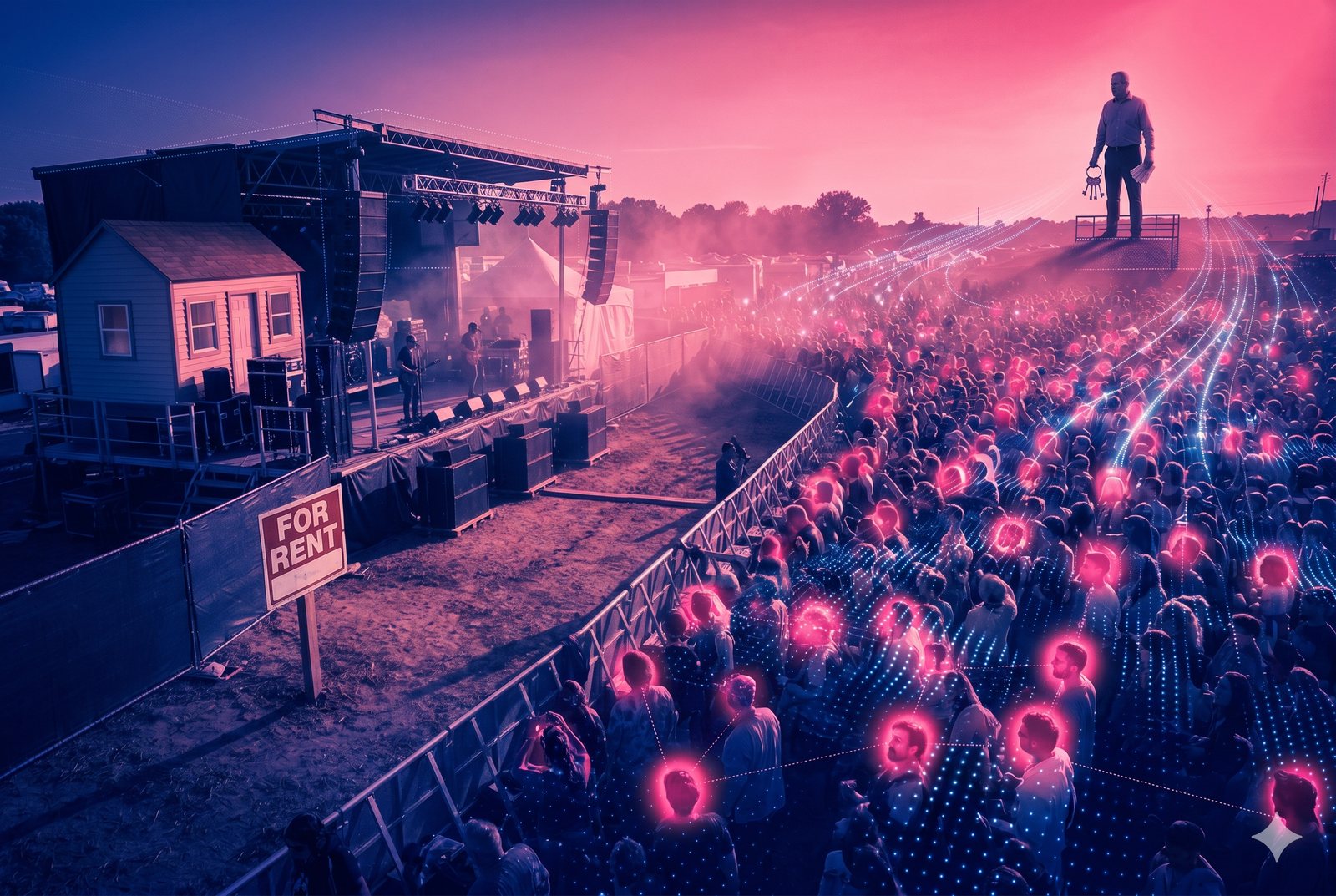
In May 2026, at an Investor Day, Spotify announced Reserved: a program that identifies an artist's most dedicated fans — by streams, shares and listening activity — and reserves them a ticket pre-sale window before the general public. It looks like a gift to the fan. And, in part, it is. But for anyone building an artist's career, Reserved is the closing line of a story that began more than a decade ago — and every manager needs to read it to the end.
First, the land is rented
Start at the beginning. Today, an artist's audience lives mostly on platforms the artist doesn't control: Spotify, Instagram, TikTok. Millions of followers and listeners — and not one of them is truly yours. You don't have the email, the phone, the city or the history of the people who listen to your artist every day. That data stays with the platform. The artist is a tenant on land that feels like their own — until the day the landlord changes the rules.
And the landlord does change the rules
The best proof isn't in a speech — it's in Spotify's own technical record. In 2014, the company opened its Web API with twelve endpoints and a generous promise: catalog data, free, for any developer. Within a few years it became one of the richest music-data platforms in the world — you could build analytics tools, recommendation engines, discovery features, entire dashboards on listening behavior.
Then the door began to close. In November 2024, with no warning, Spotify removed core endpoints at once — among them audio features, audio analysis and recommendations — and framed it as “security,” citing the misuse of data to train AI apps. In 2025, it restricted who could even qualify for full access: only registered businesses with 250,000 monthly active users. In February 2026 came another wave of removals, and whole fields disappeared from responses — track popularity, artist follower counts, user country and email. Eighteen months on, what's left is a lean, walled API, truly accessible only to large companies.
This isn't a story about code. It's a story about power. Whoever built on that land — developers, tools, startups — lost access overnight, with no say in the matter. The asset was never theirs.
The ending: Reserved
Now connect the two ends. The same Spotify that spent eighteen months making sure third parties couldn't access listener-behavior data is the one that, in 2026, uses exactly that data — which only it holds — to identify an artist's superfans and open the pre-sale door to them. The capability it denied everyone became its own competitive advantage in live. (To be fair: this bridge between closing the API and launching Reserved is my reading of the two announcements, not something Spotify has stated — but the sequence of facts speaks for itself.)
And notice where this happens: not on a like, not on a play. On the ticket — the highest-intent moment in a fan's life. Spotify rightly says it charges no added fee on the ticket. But that's not where the gain is. The gain is the relationship: Spotify is the one identifying who your superfan is, its app sends the notification, its email lands in the fan's inbox, its Premium loyalty deepens. Announced at an Investor Day, Reserved is, above all, a retention and positioning lever — Spotify placing itself, structurally, between the artist and their most valuable audience.
And the ticket is no detail. Spotify's own figures show that superfans — roughly 2% of listeners — account for half of an artist's ticket sales. It's the most valuable slice of the audience, and it's exactly the slice Reserved is built around. Whoever controls access to the superfan controls the most profitable part of the career.
The asymmetry — and the other path
Look at the imbalance. The superfan is identified by Spotify's criteria, not yours. The channel is theirs. The relationship is theirs. And the artist — who generated all that listening — keeps none of it: not the fan's name, not the contact, not the learning. If tomorrow Spotify changes Reserved, ends the program or shifts the rules (and the API record shows it does), the artist is back to zero. Again.
There's another path, and it doesn't depend on asking Spotify for anything. It's owning your own data: using streaming, social and live as top-of-funnel and channeling all of it into a base you own — email, WhatsApp, SMS — that no one can shut down with a blog post. With that base, it's the artist who identifies the superfan, who opens the pre-sale, who sends the message, who learns each cycle. Reserved stops being a threat and becomes just another channel — useful, but not essential.
For now, Reserved is U.S.-only. It will reach Brazil — programs like this always do. The question for every manager is simple: when it arrives, will your artist depend on Spotify to reach their own superfans? Or will they already own that relationship? The time to answer is before the rule changes — not after.